Scotland keeps its Independence
After 1189, when William the Lion bought the independence of
Scotland for a sum of 10,000 gold marks, there was peace with
England for over a hundred years. William's successor Alexander
II and his son Alexander III concentrated on opponents nearer
home, like the Lords of Lorne and the Lords of the Isles, who
recognized the king of Norway, not Scotland, as their overlord.
These efforts by the Scottish kings roused (рассердили)
old King Haakon of Norway, and in 1263 a large Norwegian force
appeared in the Clyde. Bad weather scattered (разметала)
the ships, but the Norwegians managed to force their way ashore
in Ayrshire. There Alexander met them and soundly beat them
in the battle of Largs. As a result, Norway gave up the Hebrides
to the king of Scots. However, the Lord of the Isles, caring
little for overlords, whether Norwegian or Scots, continued
to behave as an independent prince.
In 1286 Alexander III died after a fall from his horse. His
sons had died before him, and the heir to the kingdom was a
baby girl, Margaret, daughter of the king of Norway and Alexander's
granddaughter. Scotland was left again without a strong head
to wear the crown, at a time, unfortunately for the Scots, when
the English crown was resting on a very strong head indeed,
that of Edward I.
Edward suggested that the 'Maid of Norway' should marry his
son. He sent a ship, with boxes of sweets, to fetch her, but
she died on the way from Norway. Who was to reign now? Several
nobles had claims of a kind, and the strongest candidates were
Robert Bruce and John Balliol. Edward hastened to Scotland,
declaring that he would help to judge who had the better claim.
Under his menacing (грозный) eye,
the Scottish nobles selected Balliol, Edward's choice.

Роберт Брюс, 1274 - 1329
It was obvious that Edward's real aim was to gain control of
Scotland himself. His chief reason for preferring Balliol to
Bruce was that he believed Balliol would do what he was told.
He knew both men, for both had fought with him in France and
both held lands in England, which made them Edward's vassals.
Neither the Scots nor the English were yet a nation in our
sense of the word. Edward I could count on support from the
many Scottish nobles with English estates if he interfered in
Scotland. When Balliol rebelled against his control, Edward
invaded Scotland and defeated him with the aid of many Scots,
including Bruce.
Balliol fled to France. Edward stormed through Scotland and
forced the Scots to recognize him as king. When he returned
to England, he left Scotland under English rule and carried
away with him the Stone of Scone - the symbol of Scottish kingship
brought from Ireland by the Scots of Dalriada 700 years earlier.
Trouble soon broke out. The leader of Scottish resistance was
Sir William Wallace, who defeated an English army near Stirling
(1297) by delaying his attack until the English were halfway
across a bridge. This brought Edward, the 'Hammer of the Scots',
to the scene once more. Wallace was defeated and, after seven
years of guerilla fighting, captured and executed as a traitor
in London.
A more powerful leader then arose. In 1307 Robert Bruce (son
of Balliol's rival (соперник))
had himself crowned king of Scots at Scone. He was swiftly defeated
by the English and had to flee to the Highlands for safely,
but the flame of independence was not put out. Like the spider
which, an old legend says, Bruce watched trying to climb its
web while he was hiding in a cave, Bruce never gave up. The
Black Douglas, his friend and ally, boldly drove the English
out of his own castle. The ancestors of great clans like Campbell
and Donald gave their support to Bruce. The English, in their
captured fortresses, hung on grimly.
In 1307 Edward I, now old and failing, marched north yet again.
But the Hammer of the Scots had struck his last blow. In Cumbria,
his steps faltered, and at Burgh Sands, north of Carlisle, he
died. His son, Edward II, who was no warrior, broke off the
campaign.
One by one the English strongpoints in Scotland fell to Bruce
and his men. By 1314, only Stirling was left. Pulling himself
together, Edward II marched to the relief of Stirling castle.
By the Bannock burn (stream), in sight of the castle, Bruce
met him and routed (наголову разбил)
him.

Битва при Бэннокберне, 1314 год
The battle of Bannockburn was the greatest victory the Scots
ever won against the English. Although it marked the beginning,
not the end, of a long war, it ensured the independence of Scotland
from the English for 400 years.
Wales and the English Conquest
From Saxon times the English kings had tried to make Wales
part of their kingdom. Some had been more successful than others,
and the power struggle between England and Wales had swung to
and fro like a seesaw: for a time Wales would be subdued, then
a new outbreak would drive the English out, then a new English
campaign would restore the balance.
In 1196 the Lord Rhys, justiciar of South Wales under Henry
II and organizer of the greatest eisteddfod ever seen, died.
After him, the royal house of Gwynedd, North Wales, provided
the chief leaders of the Welsh. Llewelyn ap Iorwerth, 'the
Great', who reigned for nearly half a century, almost succeeded
in establishing a single united kingdom. He acknowledged the
king of England as his personal overlord, but ruled most of
Wales entirely in his own right.
Llewelyn was succeeded by his son David II, who died in 1246
without a direct heir. His brother Gruffydd, who had been killed
by the English, left three sons, Owen, Llewelyn and David,
to divide the inheritance between them.
The most famous of the three is Llewelyn ap Gruffydd. He is
a great Welsh hero for his resistance to the English. Yet in
the end Llewelyn, because he refused to give up, ensured that
Wales would be brought permanently under the direct rule of
the English government.

Лливелин ап Грифид, последний независимый правитель Уэльса.
Памятник в городе Лландовери
For about ten years Llewelyn ap Gruffydd ruled nearly all
Wales without serious opposition. But he failed to pay agreed
taxes to England, he avoided making his oath of loyalty to the
English king, and he plotted with the French, and with rebellious
English barons, against the king. These were risky tactics,
even if Llewelyn's position in Wales were secure. It was not:
he had quarrelled with his brother David, and in 1274 David
fled to England.
Three years later Llewelyn's power suddenly crumbled. As the
English armies advanced on Wales, his support withered away
in Powys and South Wales. Within a few months he found himself
no more than Prince of Gwynedd and humble vassal of Edward I.
In those days there were great differences between the Welsh
and the English. They were different races with different customs
and, more important, different laws. Having subdued the Welsh,
Edward said they should keep their old customs, though whether
he was sincere or not, arguments over laws and language broke
out frequently between Welsh and English.
In 1282 the Welsh rose in revolt. This time Llewelyn was in
alliance with his brother David and the princes of the south.
It was almost the first, and the last, truly national revolt.
The powerful forces of Edward I approached - knights from Gascony,
mercenaries from Flanders, the great Marcher lords, and fighting
men from all over England. There could be only one result. Llewelyn
ap Gruffydd was killed while attacking an English castle. Edward
had his head stuck on a spike at Conway Castle, with a wreath
of ivy as a crown: an old Welsh story said that a Welsh prince
would one day be crowned by the English. David, after being
driven across North Wales, was betrayed to the English, who
executed him as a traitor. All resistance ceased.
Welsh independence was lost for ever. Edward built great new
castles at Conway, Caernarvon, Harlech and other places to guard
against a revival in North Wales. The government was reorganized
on the English pattern: the country was divided into shires
with a sheriff ('shire reeve (смотритель)')
for each shire (these shires disappeared in 1974 under a new
local government act). The towns, inhabited mostly by Englishmen
and pro-English Welsh, were strengthened and given charters
of rights and liberties. But not even Edward I cared to challenge
the Marcher lords: they remained supreme.
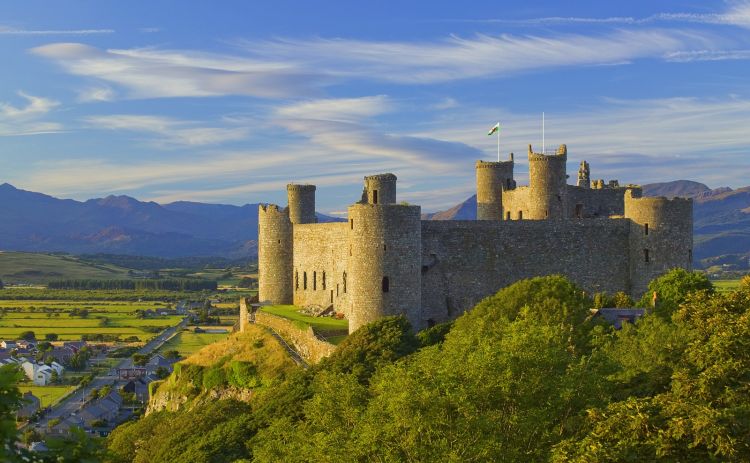
Замок Харлек (Harlech Castle) построен Эдуардом I для усиления
английского влияния в Уэльсе
While Edward was at Caernarvon in 1284 his eldest son was born,
and the king declared that, since Llewelyn's line was extinct,
he would present the Welsh with a new prince who 'could not
speak a word of English'. It was a conqueror's joke.
But not only a joke. Seven years later, the young prince was
created Prince of Wales and the eldest son of the English monarch
has been given that title ever since.
History of Britain
(История Британии)
Уважаемый
посетитель, Вы зашли на сайт как незарегистрированный пользователь.
Для более полного отображения материалов сайта мы рекомендуем Вам зарегистрироваться
либо зайти на сайт под своим именем. |


